|

|
Vibrant mosaics are among the treasures of Ravenna
By ALAN SOLOMON
(Chicago Tribune)
RAVENNA, Italy — This isn't a reason Americans come to Italy. People come here to do Venice or see the pope or find the perfect tortellini.
This is a place that falls under the category of, "We had a couple of extra days and as long as we were in the neighborhood."
But those who do find their way to Ravenna discover something unforgettable.
In the heart of this pleasant little city of 135,000 less than two hours from Bologna are six cultural monuments found on UNESCO's World Heritage List. Two more are on the edge.
One of the eight is a mausoleum that will be of interest mainly to those with a thing for Ostrogoths — but the other seven are eye-poppers.
It's the mosaics.
Now, I know not all of you are keen on pictures of people and goats and things fashioned from little tiles. We've seen them. The Romans put mosaics into the floors of their baths, and many fragments survive, from Morocco to Turkey. They're kind of interesting.
Some of the finest examples of the art anywhere can be found just down the road, in the (20th century) St. Louis Cathedral.
In Ravenna, the mosaics' antiquity is undeniably part of the charm. They date to the fifth and sixth centuries, just beyond the city's brief reign as capital of the Roman Empire. This fleeting status came well past the Empire's glory years.
Some of the artwork already was 900 years old when Dante — of "The Inferno" — was chased out of Florence, found refuge in Ravenna and never left. You can visit his tomb.
That the mosaics survived the dual whammy of the Dark Ages and the image-slashing iconoclasts — plus bombing by U.S. and British planes during the latter stages of World War II that flattened less-fortunate city structures — certainly adds to the wonder.
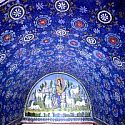
But these aren't just old, and they're more than survivors. These are brilliant, both in color and in execution.
The artists were probably Greek, but no one knows for sure.
The mosaics are in churches, chapels and a mausoleum, so it should come as no surprise that the subject matter is primarily biblical, with occasional nods to the emperors and public officials of the time.
To rank them on a best-to-worst scale is folly, especially by someone without credentials as a mosaic-evaluator, art critic or biblical scholar.
But I can talk of favorites.
In order:
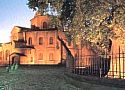
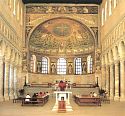
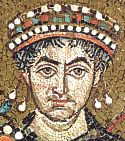
• The Basilica of St. Vitale. Extraordinary from the outside — this is not your standard 6th century rectangular church building — the inside is beyond extraordinary. The mosaics are endless, and they are spectacular. Justinian, the emperor, is depicted here, a political gesture in a hall that also celebrates saints and prophets and stories from both testaments. Non-mosaic trim on columns and arches, decoration that doesn't represent living things, resembles the geometric patterns that centuries later would add grace to great mosques. If you come to Ravenna and have limited time, this is the essential stop.
• The Arian Baptistery. From the exterior, it's just a little outbuilding alongside the larger Church of the Holy Spirit, itself a sixth century church that long ago lost its tiles. But step into the baptistery and look up into the dome, and there — in vivid colors that suggest it was installed last Tuesday — is a marvelous mosaic depiction of Christ, half-submerged, being immersed by John the Baptist. Extending from this central scene like spokes of a great wheel are the 12 apostles, separated by date palms.
It's at once simple and complex; visitors linger here, some flat on their backs, looking up and taking it all in, one apostle at a time.
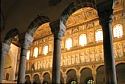
• Basilica of St. Apollinare in Classe. Three miles from town, reached easily by bus or laboriously by bicycle (a paved bike path helps toward the finish), this was once the main church of a great port city built by Augustus Caesar that long ago was silted out of existence. Today's Classe is essentially hayfields and a few stores that sell refreshments and souvenirs just off a major roadway — but none of that matters. What does are yet more spellbinding mosaics, these made lovelier by the gentle natural light that pours into the church between a succession of marble columns.
• The Neonian Baptistery. More great stuff — another baptism in the dome, of course, plus apostles — but what lifts this above some of the other sites is the closeness factor: Some mosaic-covered walls are almost at arm's reach here, rather than being up and away. Here, visitors can see each individual tile and how they work to create shadings and subtleties — yet seeing, in a sense, the process in no way diminishes the magic.
To suggest the other sites are redundant is a little like saying "seen one Van Gogh, seen 'em all." In short, that's nonsense. I saw six of the seven major Ravenna sites with mosaics and never wearied of tiles and what they could do; the seventh, the Oratory of St. Andrea, was closed for renovation, and guidebook pictures of the interior made me regret that. I skipped the mosaicless Mausoleum of Theodoric because — well, let's just say I ran out of time.
All except that mausoleum (a bit out of the way, though walkable) and the church at Classe can be easily reached on foot from anywhere here, and walking the streets of Ravenna is a pleasure. There are more churches and statuary, ancient towers, restful piazzas, shops to browse and restaurants to sample in this compact town.
The annual Ravenna Festival (late June through late July) is a monthlong celebration of the performing arts featuring operas, dance and appearances by leading classical orchestras and conductors (this year including Zubin Mehta, Lorin Maazel and Riccardo Muti).
Even then — and I was here during the festival — the city feels relaxed, uncrowded, a town of bicycles and strolling pedestrians rather than one of buzzing Vespas and tourist hordes.
For the peace alone, Ravenna makes a nice break on an Italian itinerary.
The mosaics make it priceless.
IF YOU GO: RAVENNA
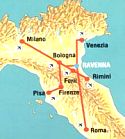
• Getting there: From Bologna — the nearest large city — the 52-mile train ride takes about 1 hour 20 minutes. Trains leave almost hourly throughout the day. My second-class seat cost about $11 round-trip (subject to change and exchange-rate fluctuations). Visitors from other major towns will have to change trains en route.
Driving to Ravenna isn't a problem. From Bologna, it's a 45-minute drive; it's about 2½ hours from Florence (85 miles) or Venice (90 miles). Rimini, the Adriatic resort town, is 32 miles down the coast. The problem may be stashing the car. Much of the historic center is limited to pedestrians at least part of the time, and many of the hotels are in that historic center. If you're planning on staying overnight, check with your hotel on parking options.
• Getting around: Ravenna is compact, which means just about everything worth seeing is within a reasonable walk from anywhere in town. If you're in a hurry — which you shouldn't be — do what the locals do and ride a bike; a limited number are available for your use, free, at the town's main tourist office.
Taxis do exist for the few sights (notably Theodoric's mausoleum, walkable for good walkers, and the Basilica of St. Apollinare in Classe) that are more than an easy stroll away.
• Staying there: In high season (April-May, September-October) and during special events (especially weekends during the June-July Ravenna Festival), rooms can get scarce, so it's best to reserve ahead.
If you're hauling luggage, the top choices near the train station (prices include breakfast, are subject to change, exchange rates and some seasonal variation) are the four-star, near-posh Jolly Hotel (doubles, $180-$184; 011-39-0544-216055; www.jollyhotels.com) and the three-star and cute Hotel Italia ($136; 011-39-0544-212363; www.hitalia.com), both a short bag-roll away.
The three-star Hotel Centrale Byron is just off the very pleasant Piazza del Popolo, and its larger doubles ($123; 011-39-0544-212225; www.hotelbyron) are especially nice. Nearby Albergo Cappello (011-39-0544-219813; www.albergocappello.it) is a three-star inn with great ceilings and rates starting at $129, but pop for one of the three 130-euro junior suites; they're dazzlers.
• Dining there: Come on, this is Italy. You'll eat well. This is based on a quick eat-through:
You'll find culinary heaven in the tortelloni with butter and fresh sage at Ristorante La Gardela (011-39-0544-217147), served outside beneath a 1,500-year-old leaning (but secured) tower. At Trattoria-Ristorante Al Rustichello (011-39-0544-36043), just outside the old city walls, they serve up a pan of cappelletti with asparagus in a prosciutto-cheese sauce that's so good, and served so graciously, you'll want to move in.
• Information: Check with the Italian Government Tourist Board at 500 N. Michigan Ave., Suite 2240; Chicago, IL 60611; phone 312-644-0996;
www.turismo.ravenna.it/eng on the
Web
|
